Some links on this page are Amazon affiliate links. If you buy through them we may earn a commission at no extra cost to you. It does not change what we recommend.
Home Depot's guidance for live trees and shrubs is the same rule as for Christmas trees: 100 mini lights or 50 C7 lights for every vertical foot, halved for thin planting.
For shrubs that rule needs one adjustment, because a shrub's shape varies far more than a Christmas tree's.
Height is not enough on its own
A 3-foot conical shrub and a 3-foot shrub that sprawls six feet wide have nothing like the same surface to cover. Height alone cannot tell them apart, so the per-foot rule gives the same answer for both, and it is wrong for one of them.
The practical fix is a spread adjustment:
| Shape | Multiplier | A 3 ft shrub takes |
|---|---|---|
| Narrow — taller than it is wide | × 1 | 300 mini lights |
| Average — roughly as wide as tall | × 1.5 | 450 |
| Wide — a broad, spreading shrub | × 2 | 600 |
This is an adjustment, not a published standard — there isn't one. It is clearly labelled as such in the calculator so you can override it.
Run your own numbers
The calculator does the arithmetic on this page for your own measurements — trees, rooflines, columns, railings, shrubs and windows.
Open the calculatorA typical front border
Three average shrubs at 3 feet:
- 100 per vertical foot × 3 ft × 1.5 spread = 450 per shrub
- × 3 shrubs = 1,350 mini lights, or about 14 boxes of 100
That is more than most people expect from three small shrubs, and it is the reason borders often end up looking thinly lit: the lights were bought by eye.
In incandescent minis, 1,350 bulbs draw roughly 540 watts — well over a third of the 1,440 watt continuous-load limit for a 15 amp circuit, for the planting alone. In LED it is under 100 watts. Front borders are where incandescent displays run out of circuit.
String lights or net lights
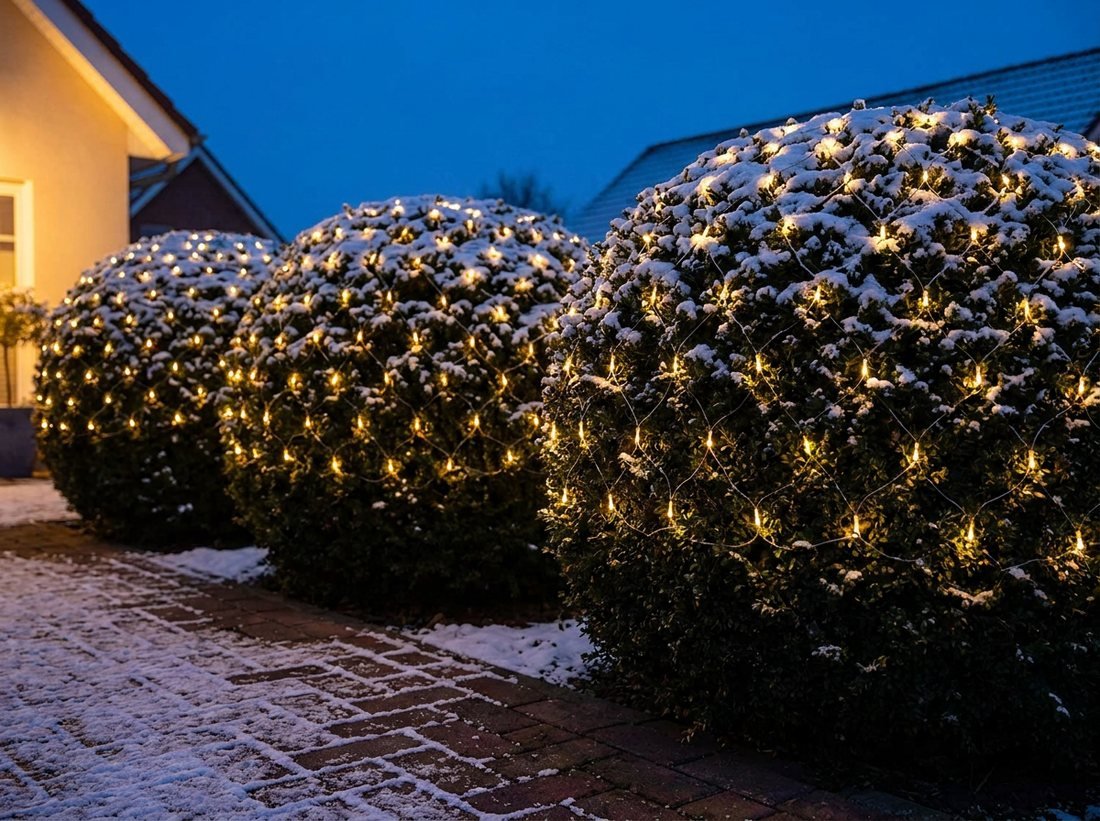
Net lights are a mesh of bulbs you drape over the shrub in one movement. For a rounded, uniform shrub they are far faster than wrapping, they space themselves evenly, and they come off in one piece in January. Sold by the area they cover, so measure the shrub's width and height and buy a net that matches.
String lights are better for anything irregular — a shrub with distinct branches, a climbing plant, a shaped hedge — because you can follow the form. Slower, and the result is better where the plant has a shape worth following.
The usual answer for a front border of rounded shrubs is nets. The usual answer for one architectural specimen is string.
- Net lightsDrape over rounded shrubs in one pass; sized by coverage areaSee options on Amazon
- Mini LED light stringsFor shaped or irregular planting where you follow the formSee options on Amazon
- Light stakes and ground clipsKeep cord runs between shrubs off the soil and out of the mower's waySee options on Amazon
Method
Light from the top down. Drape or wrap starting at the top so the cord falls naturally, rather than fighting gravity from below.
Keep the plug end nearest the supply. Start at the shrub closest to the outlet and work outwards, so each string's male plug points back towards power.
Don't compress the plant. Lights pulled tight into a shrub disappear inside it and damage the growth. The light wants to sit on the outer surface where you can see it.
Allow for the plant growing. Anything left on for more than a season can constrict new growth. Take them down.
Outdoors, in soil, in winter
Three things that specifically matter for planting:
- Outdoor-rated strings only. Shrubs are wet, and indoor insulation is not built for it.
- Connections off the ground. Soil holds water and the joint between two strings is where it gets in. Hang joints on the shrub or use a weatherproof cover; a plastic bag taped round a joint traps moisture rather than keeping it out.
- GFCI-protected supply. Required for outdoor outlets, and genuinely the point here — wet planting, a buried cord and a lawnmower in spring is the scenario ground-fault protection exists for.
The rest is in the outdoor safety checklist.
In spring
Mark where the cords run before the grass grows over them, or lift them entirely. A cord found by a strimmer in May is both an expensive repair and exactly the kind of damaged insulation that should never be reused.
Last reviewed November 2026.