Some links on this page are Amazon affiliate links. If you buy through them we may earn a commission at no extra cost to you. It does not change what we recommend.
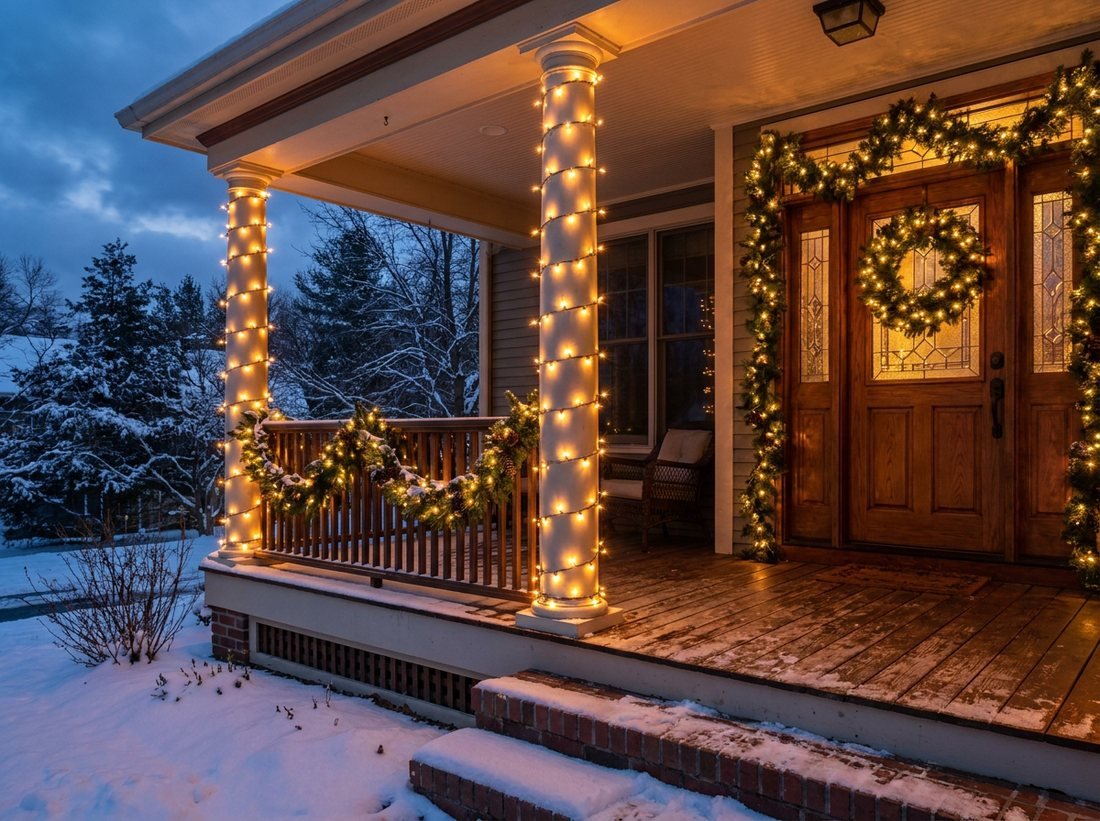
A porch is the part of a display people see from three feet away rather than thirty, so the details show. It is also the part most often done in three unrelated styles at once.
Railings: straight or spiralled
Straight along the top rail is the restrained option. The length you need is the length of the rail, plus about 5% so you are not pulling anything tight. A 16-foot rail takes about 17 feet of string.
It suits a railing with interesting balusters, because it lights them from above without competing with them, and it is the right choice if the railing is one element of a larger scheme rather than the feature.
Spiralled around the rail uses several times as much string and reads as much richer. The arithmetic is the same geometry as wrapping a trunk:
Turns = rail length ÷ gap between turns String = turns × distance around the rail
A 16-foot rail, 12 inches around, spiralled at 4-inch intervals:
- Turns: 192 in ÷ 4 in = 48
- String: 48 × 12 in = 576 in = 48 feet
Forty-eight feet for a sixteen-foot rail. Three times the straight run, which is exactly the surprise that leaves people one string short on the second side.
Run your own numbers
The calculator does the arithmetic on this page for your own measurements — trees, rooflines, columns, railings, shrubs and windows.
Open the calculatorColumns and posts
A post is a true cylinder, so the answer is exact rather than approximate. Same formula, measuring the distance around with a tape:
An 8-foot post, 16 inches around, wrapped at 3-inch intervals:
- Turns: 96 ÷ 3 = 32
- String: 32 × 16 in = 512 in = 43 feet per post
Two posts flanking a door is 86 feet. Most people would guess two strings.
Two rules for posts specifically:
Do both the same, with string bought at the same time. A pair of posts either side of a door is the most symmetrical thing in the display, and any difference in spacing or shade is glaring. If you are short, redo both at a wider spacing rather than finishing one tightly and one loosely.
Keep the spacing consistent top to bottom. The eye reads a spiral as a pattern, and a pattern that drifts looks like fatigue — which it usually is. Use your fingers as a spacer: three fingers across is close to 3 inches.
Making the porch read as one thing
Three decisions do most of the work:
One colour temperature throughout. Warm white on the posts and cool white on the railing will look like two jobs. Pick one and stay with it; see warm white versus cool white.
One bulb size per element type. Mini lights for wrapped posts and garland, where you want a continuous glow. Larger C6 or C7 bulbs for a straight run along a rail, where individual points of light read as deliberate. Mixing sizes within one element looks accidental.
Symmetry where the architecture is symmetrical, and nowhere else. If the door is centred between two posts, treat them as a pair. If the porch is asymmetric, do not force a mirror image onto it — follow what is there.
- Mini LED light stringsFor wrapping posts and running through garlandSee options on Amazon
- Garland with built-in lightsCovers a rail or door surround in one passSee options on Amazon
- Outdoor adhesive hooks and clipsFixings for painted, stucco and composite surfaces where nothing clipsSee options on Amazon
- Outdoor-rated extension cordsPorches rarely have an outlet where you need oneSee options on Amazon
Garland as the shortcut
Pre-lit garland around a door surround or along a rail top does in one pass what wrapping does in forty-eight turns. It is more expensive per foot and much faster, and on a railing it hides the fixings completely.
Measure the run and buy in one length where possible — joins between garland sections are visible from the path, and are the first thing to sag.
The practical details
Find the outlet before you start. Porches rarely have one where you want it, and the plug has to end up within reach of something. Work from the outlet outwards. An outdoor-rated extension cord is the right answer; a string of lights used as an extension lead is not.
Keep connections off the floor. Porch floors collect water and snow melt. Hang joints up, or use a weatherproof connection cover.
Nothing across a doorway or a step. A cord across a threshold is a trip hazard at the exact point where people arrive carrying things in the dark, and a door closing on a cord crushes insulation.
Fix to the structure, not through the cord. Clips for the surface you have — see hanging lights without nails. Never a staple through the cord.
Count the current too
Porch lighting looks small and adds up fast. Two wrapped posts at 43 feet each plus a spiralled railing at 48 feet is 134 feet of string, which in incandescent mini lights is in the region of 270 watts — nearly a fifth of the 1,440 watt continuous-load limit for a 15 amp circuit, before the roofline and the trees. In LED it is a small fraction of that. The calculator totals the display and flags it when it needs splitting across two breakers.
Last reviewed November 2026.