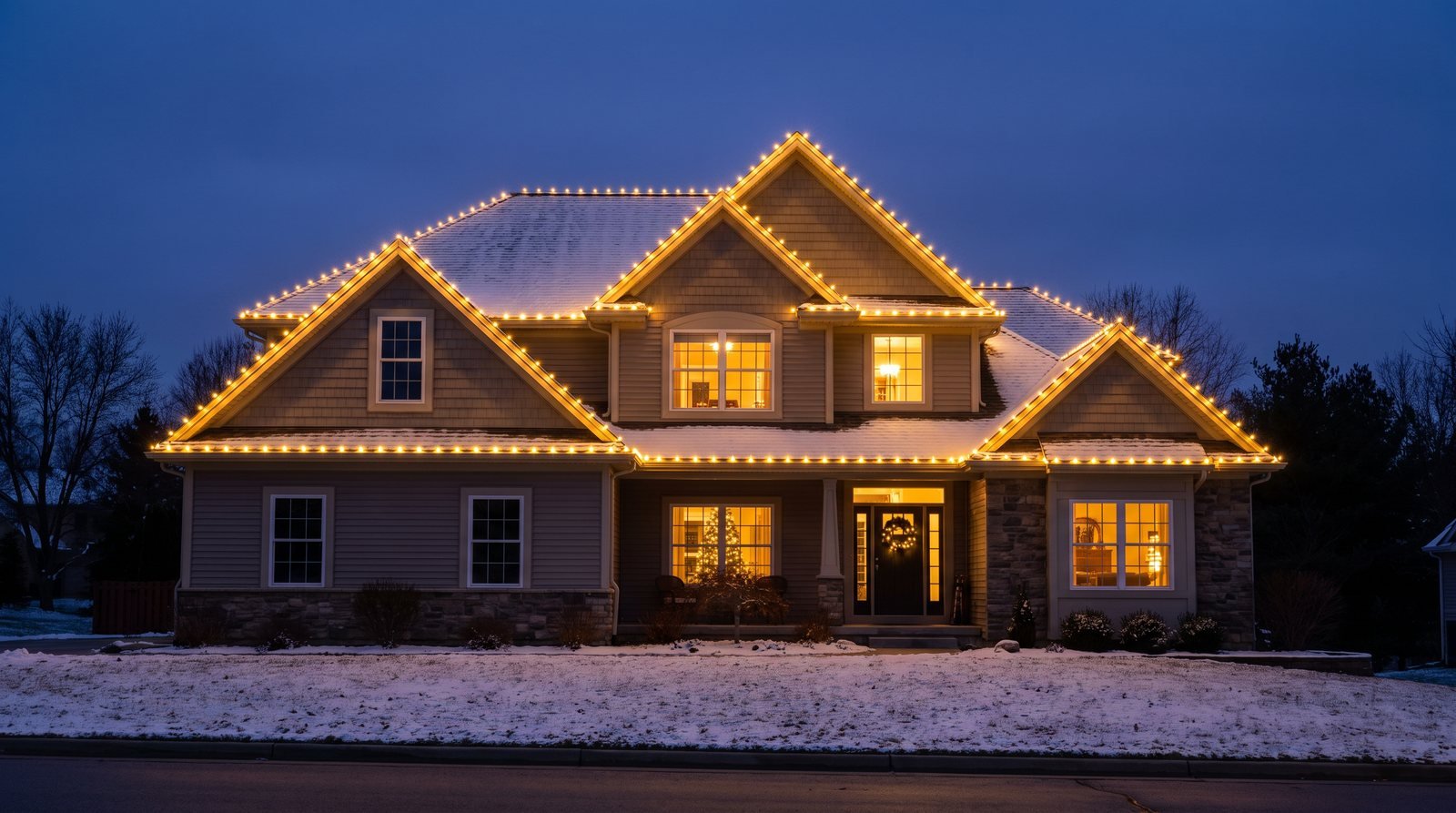
Some links on this page are Amazon affiliate links. If you buy through them we may earn a commission at no extra cost to you. It does not change what we recommend.
A roofline is not estimated by bulbs per foot. It is measured in linear feet and you buy that much string. The only question is how to measure it without spending an afternoon on a ladder.
Measure from the ground
You do not need to be on the roof. The horizontal run of a gutter is the same length as the ground beneath it.
- Walk the house with a tape or a measuring wheel, directly below each gutter and eave you intend to light. Write each run down separately rather than keeping a running total — you will want the individual figures later.
- Count your paces instead, if you have no tape. Measure one normal stride on a known length first; most adults are close to two and a half feet. It is good to within a few percent, which is well inside the slack you are about to add.
- Use the house plan or a satellite image if you have either. The footprint dimensions give you the long runs directly.
Horizontal runs measure fine from the ground. Two things do not:
- Sloping gables. A raked edge is longer than the ground beneath it. If you want the peak outlined, measure the base of the triangle and the height, then take the square root of (half-base² + height²) for each sloping side — or simply add 15 to 20% to the base measurement, which is close enough for buying purposes on a normal pitch.
- Anything above the first storey. Measure the ground floor and multiply by the number of storeys you are lighting, or compare against a known height such as a door at about seven feet.
Add what the measurement does not include
Your measured total is the lit length you need on the house. Three things get added:
| Add for | Typical |
|---|---|
| Corners and the bend around each one | a foot or two each |
| Any vertical drops | the drop height, each |
| The run from the first string back to the outlet | the actual distance |
| General slack and error | 10% |
The 10% is not padding for its own sake. String lights do not stretch, sockets land where they land, and you will want the freedom to start a run a foot earlier than planned.
Note that the run back to the outlet should be covered by an extension cord, not by lit string. A string of lights used as an extension lead is lights you paid for and cannot see, and it counts against the chain limit.
Run your own numbers
The calculator does the arithmetic on this page for your own measurements — trees, rooflines, columns, railings, shrubs and windows.
Open the calculatorIf you are shopping before measuring
Home Depot's guidance for this case is to start with at least 60 feet of string lights, and add another 10 to 12 feet for every awning you plan to light.
Treat that as a shopping-list starting point rather than an answer. Sixty feet is a modest single-storey frontage. It is no substitute for a tape, and buying by guess is how people end up with a run that stops four feet short of the corner.
Bulb spacing changes the count, not the length
Once you know the run, the length of string is fixed — but how many bulbs that is depends on their spacing. C9 and C7 bulbs are commonly spaced at around 12 inches, so a 60-foot roofline takes roughly 60 bulbs. Mini lights sit much closer together, so the same run takes several times as many bulbs and draws proportionally more power.
This is why larger bulbs dominate rooflines: fewer bulbs cover more run, the individual points of light read clearly from the street, and the wattage total stays manageable. The trade-offs between sizes are in C7 vs C9 vs mini.
- C9 LED light stringsThe usual roofline choice; large bulbs at wide spacing, visible from the streetSee options on Amazon
- Gutter and shingle clipsOne clip type per surface; no nails, no staplesSee options on Amazon
- Telescoping light-hanging poleHangs and retrieves clips from the ground instead of from a ladderSee options on Amazon
Write it down for next year
The single most useful thing to come out of measuring is a note you keep. A sheet listing each run, the number of strings it took, which clip type went on which surface, and which outlet fed what, turns next December from a rediscovery into a twenty-minute job.
Take photographs too, before you take anything down. You will not remember how the corner was arranged.
One sanity check before you buy
Add up the total wattage before you add up the cost. A long roofline in incandescent C9 bulbs, at around 7 watts each, runs into the circuit limit quickly: the continuous-load figure for a 15 amp circuit at 120 V is 1,440 watts, which is about 200 bulbs. The LED equivalent of the same run is a small fraction of that. The calculator flags it when a display needs splitting across two breakers, which is better to know in the shop than on the ladder.
Last reviewed November 2026.